
Amirhossein Ebadi
Founder & Chief Marketing Officer

A practical, data-backed guide to mastering email marketing in 2025. Learn the latest trends, automation strategies, ROI benchmarks, and ready-to-use templates to drive real revenue growth.

251,100,000 emails get sent every minute worldwide. That's more traffic than any other communication channel. Here's what matters for your business: email marketing consistently delivers $36 for every $1 you invest – returns that crush other digital marketing channels.
The numbers don't lie. Social media and paid search each deliver just 16% effectiveness for marketers. Email marketing dominates with 42% of marketers calling it their most effective channel. Companies invested $8.3 billion in email marketing during 2023, with spending projected to hit $18.9 billion by 2028.
Your customers respond to emails. Half of all consumers made purchases directly from emails in 2024. Automated emails outperform regular campaigns dramatically. Smart segmentation works – over 90% of marketers confirm its effectiveness.
Email marketing trends for 2025 focus on one thing: maximizing your marketing budget. This guide shows you exactly how to build campaigns that deliver real results. You'll get the latest strategies, proven tactics, and ready-to-use templates that work for businesses like yours.
Email marketing delivers financial returns that other channels simply can't match. Smart businesses track these numbers to maximize every marketing dollar they spend.
Email marketing ROI shows you exactly how much money your campaigns generate compared to what you spend. Simple math: if you invest $1,000 and make $36,000 in revenue, you're earning $35 profit for every dollar invested.
This metric matters because 80% of consumers worldwide prefer email as their primary communication channel. Every campaign you run either builds your business or wastes your budget. ROI tracking tells you which is which.
Here's the problem: 21% of marketing leaders still don't measure email marketing ROI. That's down from 36% in 2023, but it means one in five businesses are spending blind. You can't improve what you don't measure.
Your email campaigns should generate $36 to $42 for every dollar you invest. Some companies do even better – 18% achieve returns over $70 per dollar spent.
Industry performance varies significantly:
• Retail and ecommerce: $45 per $1 spent
• Marketing and PR agencies: $42 per $1 spent
• Software companies: $36 per $1 spent
• Financial services: $38 per $1 spent
• Travel and hospitality: $32 per $1 spent
Team size affects results. Marketing teams with 3-5 members achieve 42:1 ROI compared to 30:1 for smaller teams. Automated emails punch above their weight – they drive 37% of all email sales while representing just 2% of total volume.
Step 1: Use this formula
ROI = (Revenue – Cost) / Cost × 100%
Step 2: Track all expenses
Include email platform fees, design costs, employee time, templates, and list management.
Step 3: Measure revenue accurately
Most marketers use these approaches: • 41% rely on direct revenue attribution
• 59% analyze customer engagement metrics
• 36% use multi-channel attribution models
Example calculation: Your campaign generates $10,000 in revenue with $1,000 in costs.
($10,000 – $1,000) / $1,000 × 100% = 900% ROI
That's $9 earned for every dollar spent.
Personalization multiplies results. Businesses using personalized emails see 260% higher ROI (43:1) compared to generic campaigns (12:1). Regular A/B testing boosts ROI by 86%. Dynamic content doubles ROI compared to static emails.
Track customer lifetime value beyond immediate conversions. This shows how your email marketing builds sustainable growth over time.
Smart businesses adapt fast. These four trends separate growing companies from those stuck with outdated strategies.
AI moved from nice-to-have to must-have. 29% of marketers call AI-powered content generation the biggest game-changer this year. By 2026, 70% expect AI to handle half their email operations.
Real-time data analysis changes everything. AI predicts what customers want before they know it themselves. Companies using AI-driven email strategies see 10x higher engagement rates. Hubspot's personalization experiments delivered an 82% conversion rate boost.
Your AI capabilities include:
86% of consumers worry about privacy more than ever. Privacy-first marketing isn't optional anymore—it's how you build trust and stay compliant.
Stakes get higher each year. GDPR fines reach €20 million or 4% of global revenue. CCPA violations cost $7,500 each. Smart consent practices matter—72% of subscribers expect transparency when joining your list.
Effective email privacy means choice, clarity, and genuine value. Use data subscribers expect you to use. Keep every action simple, visible, and voluntary. No tricks, no dark patterns.
70% of email opens happen on mobile devices. Your audience checks promotions during commutes and reads newsletters over morning coffee on their phones.
Mobile-optimized emails deliver higher click-through and conversion rates. Poor mobile experiences hurt performance and damage your brand. Focus on responsive layouts, thumb-friendly buttons, concise copy, optimized images, and single-column designs that work fast.
Mobile-first design also meets accessibility requirements under the European Accessibility Act and ADA guidelines.
Segmentation got smarter. Marketers moved beyond basic demographics to behavioral and psychographic insights. Segmented campaigns drive 30% higher open rates, 50% more clicks, and 20% fewer unsubscribes.
2025 leaders use predictive models to identify likely buyers, spot subscribers ready to churn, personalize send times, and recommend products based on past behavior. Smart segmentation divides frequent buyers from one-time customers, segments by acquisition source to understand channel quality, and filters by subscription tiers to compare engagement patterns.
Effective segmentation means understanding subscribers deeply and delivering messages that feel timely, personal, and valuable.
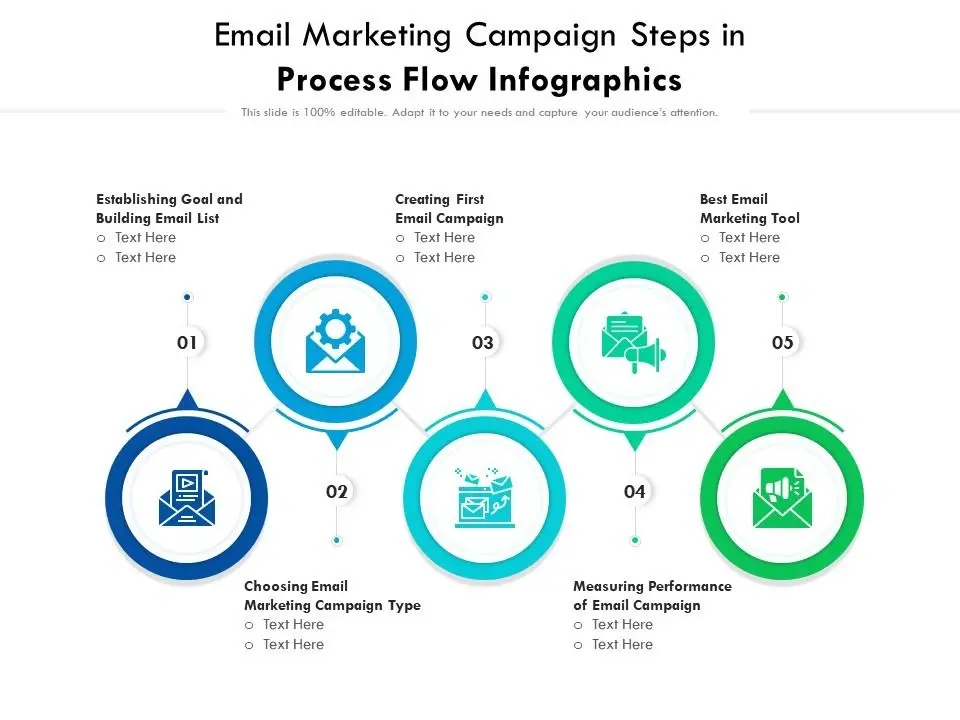
Your email success depends on the right framework. Here's our proven six-step process that builds campaigns generating real business results.
Start with SMART goals—Specific, Measurable, Attainable, Relevant, and Time-bound. Your objectives should connect directly to business growth: list expansion, higher engagement, increased revenue, reduced cart abandonment, or improved customer lifetime value.
Skip vague targets. Set precise benchmarks like "boost email-driven revenue 15% in Q2" or "cut unsubscribe rates 3% within six months."
Smart segmentation delivers 46% higher open rates. Map out your data strategy first: what customer information do you already collect, what can you start tracking, and what additional details might you need from subscribers?
Create targeted groups using demographics, behaviors, preferences, and sales funnel position. This focused approach generates your $36 return for every dollar spent.
Your technology stack makes or breaks campaign performance. Focus on platforms with strong deliverability—emails stuck in spam folders kill your strategy.
Essential features include drag-and-drop editors, advanced automation, personalization capabilities, segmentation tools, e-commerce integration, and reliable support. Pick tools that help you sell more with less work, not the ones with the most features.
Your subject line creates the first impression. Poor subject lines cause 30.4% of readers to unsubscribe. Write benefit-focused headlines that communicate clear value.
Personalize content for each audience segment. Use action-oriented language. Emails with question marks in subject lines get 20% open rates versus 12% without.
Automation delivers the right message at the right moment. Email triggers—events that start automated sequences—let you send targeted communications based on specific customer actions.
Map your customer journey. Build workflows for welcome series, abandoned carts, post-purchase follow-ups, and re-engagement campaigns. Automated emails drive 37% of all email sales despite being just 2% of total email volume.
Continuous testing reveals what works for your audience. A/B testing shows preferences by comparing single element variations. Test subject lines, content, CTAs, and send times one variable at a time.
Ready to optimize your email strategy? with our experts to identify specific opportunities for your business.
Ready-to-use templates save hours while boosting performance. Here's exactly what works for businesses generating consistent email revenue.
First impressions decide everything. Welcome emails get 4x more opens and 5x more clicks than regular marketing messages. Your welcome template needs:
Mobile-friendly design isn't optional—it's essential for conversions.
70% of shoppers abandon their carts before buying. That's lost revenue you can recover with the right approach.
Your recovery template must include:
Timing drives results. Send the first email within one hour for a 16% conversion rate. Follow up after 24 hours, then send a final discount offer.
Clean layouts drive engagement. Your newsletter template should feature:
Focus on readability over flashy design. Your content matters most.
"We miss you" messages work when done right. Duolingo uses their mascot with a sad face—emotional connection drives action.
Your re-engagement template needs:
ModCloth's anniversary messages with special offers show how to re-establish customer relationships effectively.
Your email campaigns need consistent care to maintain peak performance. These practices separate successful businesses from those watching their results decline.
List hygiene directly impacts your revenue. Remove invalid, duplicate, and unengaged contacts every six months to boost deliverability rates and campaign performance. Keep bounce rates under 0.5%, minimize spam complaints, and protect your sender reputation. Companies like OptinMonster maintain bounce rates below 1% through proper list scrubbing.
Performance metrics reveal which campaigns drive results. Focus on these key indicators:
Teams using third-party analytics tools achieve 25% higher ROI than those who don't.
Set up authentication protocols (SPF, DKIM, DMARC) to verify your legitimacy. Skip subject lines with excessive punctuation or ALL-CAPS text. Eliminate spam-triggering words like "free," "guarantee," and "no obligation". Your messages reach inboxes instead of spam folders.
71% of consumers say personalization influences their email engagement. Build privacy-first strategies since 86% of consumers view privacy as a growing concern.
Ready to optimize your email marketing approach? with our specialists today.
Email marketing delivers results that other channels can't match. You've seen the data. You know the strategies. Now it's time to put them to work for your business.
The trends are clear: AI-powered personalization connects with audiences on a deeper level. Privacy-first approaches build trust with customers who care about their data. Mobile-first design reaches people where they actually read emails. Smart segmentation turns your list into a revenue-generating machine.
Your success depends on execution. Set clear goals for each campaign. Build and segment your lists based on real behavior, not assumptions. Choose tools that integrate with your existing systems. Create content that speaks directly to your audience's needs. Automate the workflows that save time and drive sales. Test everything to find what works best for your business.
The templates and frameworks in this guide give you everything needed to start today. Welcome sequences that convert new subscribers. Cart recovery emails that bring back lost sales. Newsletters that keep customers engaged. Re-engagement campaigns that win back inactive subscribers.
Consistent maintenance keeps your campaigns performing at peak levels. Clean your lists regularly. Monitor the metrics that matter. Avoid spam triggers that hurt deliverability. Adapt to how your customers actually behave.
Email marketing isn't going anywhere. Smart businesses use it to grow revenue, build relationships, and stay competitive. The strategies here work for companies across industries and team sizes.
Start with one campaign. Pick the template that fits your biggest opportunity. Test it. Measure the results. Scale what works.
Get Your Free Email Audit today and discover how to unlock email marketing's full potential for your business.
Q1. What is the average ROI for email marketing in 2025? The average return on investment for email marketing in 2025 ranges between $36 and $42 for every dollar spent, representing a 3,600% to 4,200% ROI. Some organizations even report returns greater than $70 per dollar invested.
Q2. How can AI improve email marketing campaigns? AI can significantly enhance email marketing by enabling personalized content creation, predicting customer intent, optimizing send times, and generating tailored subject lines. Organizations using AI-driven strategies report up to 10 times higher engagement rates.
Q3. Why is mobile-first design important for email marketing? Mobile-first design is crucial because over 70% of email opens now occur on mobile devices. Mobile-optimized emails achieve higher click-through and conversion rates, while poor mobile experiences can hurt performance and damage brand perception.
Q4. What are some effective strategies for list segmentation? Effective list segmentation strategies include dividing subscribers based on purchase frequency, acquisition source, and subscription tiers. Marketers also use predictive models to identify likely buyers, spot at-risk subscribers, and personalize send times for each user.
Q5. How often should I clean my email list? It's recommended to clean your email list every six months. Regular cleaning involves removing invalid, duplicate, and unengaged contacts. This practice improves deliverability rates, reduces bounces, minimizes spam complaints, and preserves your sender reputation.
Access our exclusive whitepapers, expert webinars, and in-depth articles on the latest breakthroughs and strategic implications of advanced automation and AI.